

Table of Contents
- What Commercial Facility Painting Involves
- Commercial Interior Painting vs. Exterior Work
- Industrial vs. Commercial Painting: Key Differences
- Getting an Accurate Commercial Painting Estimate
- Commercial Painting Project Timeline and Scheduling
- How to Choose a Reliable Commercial Painting Contractor
- Safety, Compliance, and Insurance for Commercial Projects
- Frequently Asked Questions
Last Updated: October 16, 2026
What Commercial Facility Painting Involves
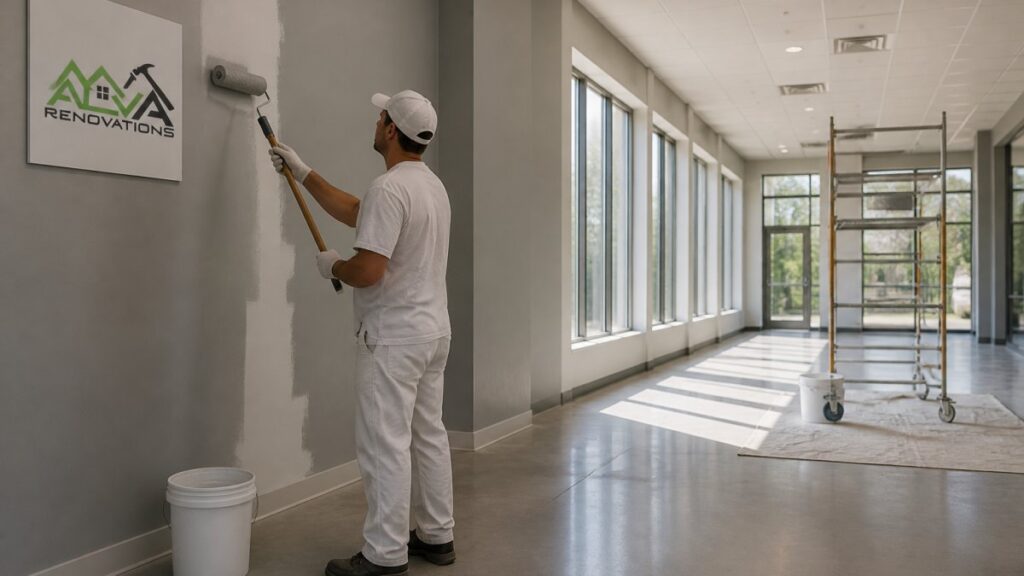
Commercial facility painting is the process of applying protective coatings and finishes to interior and exterior surfaces of business properties, office buildings, retail spaces, and multi-building complexes. Unlike residential painting, commercial work requires durability, code compliance, and minimal disruption to operations.
The scope includes surface preparation, primer, substrate-based paint selection, and finishing. Commercial-grade finishes must withstand higher traffic, environmental exposure, and regulatory requirements than residential paint. At ALVA RENOVATIONS LLC, we know commercial facility painting demands precision scheduling, quality craftsmanship, and transparent communication with property managers and business owners.
Surface preparation is where most commercial projects succeed or fail. Substrate assessment determines whether the surface needs cleaning, sanding, patching, or priming, and drywall, wood, metal, and concrete each require different approaches. Skipping this step causes premature finish failure and costly repainting within months.
Scope also includes access equipment planning, site safety protocols, and occupant coordination. Since facilities often operate during painting, scheduling around business hours, managing odor, and protecting adjacent spaces are critical logistics.
Commercial Interior Painting vs. Exterior Work
Interior painting covers drywall, trim, ceilings, and accent walls within occupied spaces. The main challenge is minimizing disruption while delivering a professional finish, often requiring after-hours or phased scheduling so staff and customers keep their routines.
Exterior painting addresses storefront facades, metal siding, concrete foundations, and weather-exposed trim. It demands coatings that resist UV damage, moisture infiltration, and temperature swings, engineered differently than interior paints for long-term durability.
Interior projects move faster because weather is not a factor and surfaces are more predictable. Exterior work requires weather monitoring, longer drying times, and equipment like scaffolding or lifts for multi-story buildings, so timelines can extend significantly with weather delays.
Choosing between interior and exterior work depends on facility condition and business priorities. Many properties need both, letting contractors coordinate scheduling and cut overall project time: interior first to avoid weather delays, then exterior once interior finishes are complete.
Industrial vs. Commercial Painting: Key Differences
Industrial painting involves heavy-duty protective coatings for manufacturing facilities, warehouses, and equipment, using specialized systems like epoxy, polyurethane, or industrial enamel designed for extreme conditions, chemical exposure, or high temperatures.
Commercial painting serves office buildings, retail spaces, and service facilities where aesthetics and durability matter equally, prioritizing appearance, ease of maintenance, and building code compliance over extreme environmental resistance.
Substrates differ significantly. Industrial projects often involve metal surfaces, heavy-traffic concrete floors, or equipment needing corrosion protection. Commercial facilities feature standard drywall, finished wood trim, and standard concrete that respond well to conventional painting systems.
Equipment and safety protocols also differ. Industrial painting may require respirators, hazmat protocols, or specialized ventilation; commercial painting typically follows standard OSHA guidelines. Both demand insurance and compliance verification, but complexity varies by facility type and coating system.
Timelines reflect these differences. Industrial projects often take longer due to preparation demands and specialized coating cure times. Commercial facility painting follows a more predictable schedule, though occupied facilities still require careful coordination to minimize disruption.
Getting an Accurate Commercial Painting Estimate
Most commercial painting pages tell you to ‘get a detailed estimate’ and stop there, rarely showing what actually drives the number. Below is the line-item structure a facility manager should expect, and the variables that move each line.
The five cost drivers that determine every commercial painting quote:
- Measurable surface area. Contractors price by paintable square footage, not building square footage. A 20,000 sq ft warehouse with 30-foot ceilings may have less paintable wall area than a 6,000 sq ft office with extensive interior partitions, trim, and ceiling grid. Ask for the measured area in square feet and the rate applied to it.
- Surface condition and preparation scope. This is the single largest swing factor. A sound, previously painted wall may need only cleaning and a spot prime. A wall with peeling latex over an unsealed substrate may need scraping, sanding, patching, and a bonding primer. Preparation commonly represents the largest share of labor hours on repaint work, and a quote that doesn’t itemize it is a quote you can’t compare.
- Coating system and number of coats. A single-component acrylic at one coat is not the same product as a two-component epoxy or a urethane topcoat. Each additional coat adds material and labor. Ask the contractor to name the specific product, the sheen, and the number of coats per surface.
- Access equipment. Ground-level roll work is the cheapest labor condition. Anything requiring a scissor lift, boom lift, swing stage, or scaffolding adds rental cost, setup time, and often a certified operator. Multi-story exteriors and atriums are the most common places where a ‘low’ bid turns out to exclude access.
- Occupancy and working hours. Standard daytime work in an empty building is the baseline. After-hours, weekend, and phased work in an occupied facility carry a labor premium because crews work shorter windows, often at night, and must protect and restore the space each shift.
What a comparable estimate should itemize:
| Line item | What to look for |
|---|---|
| Labor | Crew size, estimated hours, and hourly rate or burden |
| Materials | Product name, sheen, quantity in gallons, and number of coats |
| Surface preparation | Cleaning, patching, sanding, priming, listed separately |
| Access equipment | Type, rental duration, and operator requirement |
| Protection and cleanup | Masking, containment, daily cleanup, and final walkthrough |
| Scheduling | Start date, phasing plan, and working hours |
| Exclusions | What is explicitly not included (e.g., drywall repair, lead abatement) |
| Contingency | How unforeseen substrate conditions are priced and approved |
Ask every bidder to quote the same scope on the same form. If one contractor lists preparation and access separately and another buries them in a lump sum, you are not comparing prices, you are comparing how much risk each one has hidden.
Why quotes require a site visit. No responsible contractor can price a commercial facility from a photo or square footage alone. Substrate type, coating adhesion, moisture readings, ceiling height, and distinct surface count all change the number. Treat any phone-only quote as a placeholder, not a bid.
A note on ‘cheap’ bids. A bid well below the others is usually not a discount, it is a different scope. Common omissions are preparation depth, primer, an extra coat, and access equipment. Ask the low bidder to confirm each in writing before comparing.
Commercial Painting Project Timeline and Scheduling
Timelines depend on facility size, surface condition, and occupancy during work. A small commercial space might take 2-4 weeks, while a large multi-building complex could require 8-12 weeks or longer.
Scheduling around operations is a primary timeline driver for occupied facilities. After-hours, weekend, or phased work slows progress versus full-facility access, so the contractor must coordinate with property managers to find windows that avoid disrupting tenants or customers.
Surface preparation usually takes longest. Cleaning, sanding, patching, and priming can consume 50% of total project time on older facilities with poor surfaces, while newer, well-maintained buildings move faster into paint application.
Drying and cure time affect the schedule. Commercial-grade paints may need 24-48 hours between coats depending on humidity, temperature, and ventilation, and the contractor should plan for weather delays and temperature swings that slow drying on exteriors.
A realistic timeline includes buffer days for unexpected conditions, material delays, or weather. Contractors promising unrealistically fast completion often cut corners on preparation or drying, hurting finish quality.
How to Choose a Reliable Commercial Painting Contractor
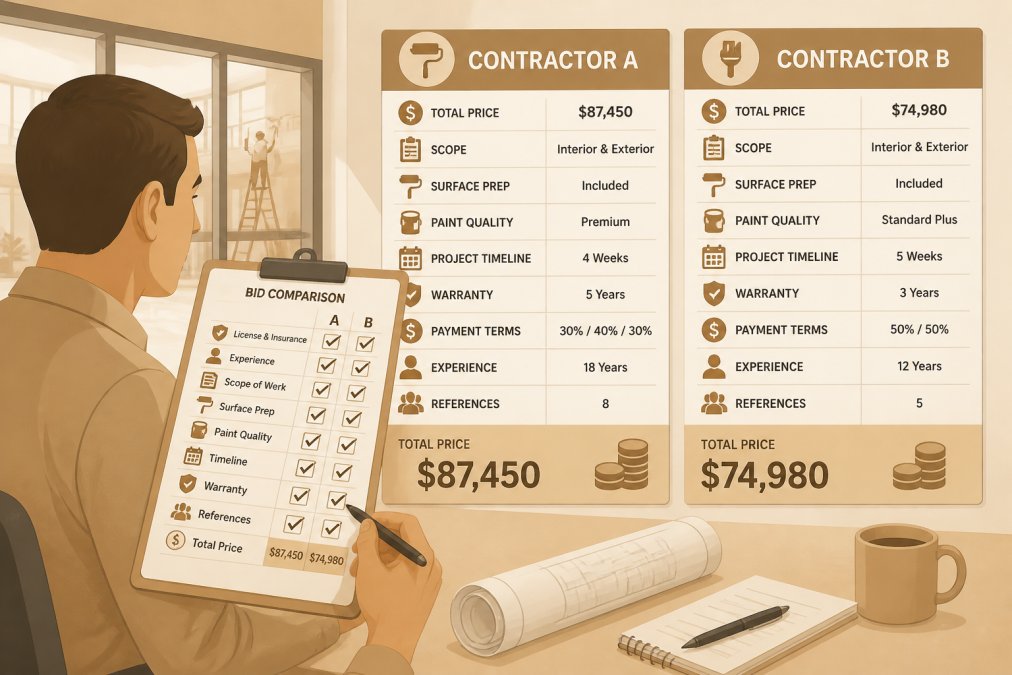
Most pages tell you to check references and insurance, the floor, not the differentiator. What facility managers need is a side-by-side scoring method so two or three bids can be compared on the same criteria instead of price alone.
A neutral comparison checklist. Score each bidder on the criteria below, using the same scale, before you look at the bottom-line number.
| Criterion | What ‘strong’ looks like | What to watch for |
|---|---|---|
| Scope clarity | Written scope naming surfaces, products, sheens, and coat counts | ‘Paint interior’ with no surface list |
| Credentials | Active license, general liability, workers’ comp, and bonding on file | Certificates ‘available on request’ only |
| Safety program | Written fall-protection, ventilation, and PPE procedures; OSHA-aligned training | Verbal assurances with no documentation |
| Scheduling | Phasing plan tied to your operating hours, with buffer days | A single completion date with no phasing |
| Communication | Named point of contact and a defined update cadence | No named contact until the crew arrives |
| Warranty | Written terms covering adhesion and workmanship, with a stated duration | ‘We stand behind our work’ with no document |
| Project evidence | Completed commercial projects with scope, facility type, and timeline | Residential photos only |
| Change-order process | Written procedure for pricing unforeseen conditions before work proceeds | Verbal approval and a surprise invoice |
Verify credentials, don’t just collect them. Request certificates of insurance directly and confirm coverage limits fit your facility’s value and the project’s exposure. For pre-1978 buildings, ask how the contractor handles lead-safe work under the EPA’s Renovation, Repair and Painting rule, a contractor who cannot answer is a risk on older properties (the EPA).
Read the warranty, not the brochure. Terms vary widely: some cover materials only, some workmanship, some prorate over time.
Plan for maintenance, not just this project. The lowest-cost coating is rarely the lowest total cost of ownership. A durable commercial-grade system over properly prepared substrate outlasts a budget coating, meaning fewer repaint cycles, less disruption, and lower lifetime labor.
Ask for project evidence that matches your facility type. A contractor who has painted retail understands customer access and merchandising protection; one who has worked in occupied offices understands noise, odor, and after-hours phasing; one who has handled multi-building complexes understands staging and coordination.
Price is the last column you fill in, not the first. Compare scope, credentials, safety, scheduling, warranty, and evidence first, then compare price against the scope each bidder actually committed to. The lowest number on a narrower scope is not a lower price; it is a different project.
Safety, Compliance, and Insurance for Commercial Projects
Commercial painting projects must comply with OSHA standards, building codes, and local regulations. The contractor should hold current OSHA certifications, follow fall protection protocols for elevated work, and ensure proper ventilation when using solvent-based paints or primers.
Insurance verification protects your property and operations. General liability covers damage to your building or adjacent properties; workers’ compensation covers contractor employees injured on the project.
Permits and inspections may be required depending on scope and local jurisdiction. Some municipalities require permits for exterior work or projects affecting building appearance.
Safety protocols on occupied facilities include dust control, odor management, and restricted work-area access.
Documentation of completed work protects both parties.
| Compliance Element | Requirement | Verification Method |
|---|---|---|
| Insurance Coverage | General liability + workers’ comp | Certificate of Insurance |
| OSHA Compliance | Safety protocols and certifications | Contractor credentials |
| Building Permits | Local jurisdiction requirements | Permit documentation |
| Safety Equipment | Fall protection, ventilation, PPE | Site inspection |
| Warranty Documentation | Written coverage and terms | Warranty agreement |
Choosing a commercial facility painting contractor requires evaluating experience, insurance, communication practices, and pricing alignment with scope. ALVA RENOVATIONS LLC brings structured project management, transparent communication, and commitment to quality craftsmanship to every commercial facility painting project.
Frequently Asked Questions
What should a commercial painting estimate include?
A detailed commercial painting estimate should list surface preparation costs, paint type and quantity, labor hours, equipment rental, project timeline, and warranty terms. It should break down interior and exterior work separately, specify coating systems or commercial-grade finishes being used, and outline any additional costs for substrate repair or access equipment. A written estimate protects both parties and prevents scope creep.
How long does a typical commercial painting project take?
Commercial painting project timelines depend on facility size, surface condition, and whether work occurs during business hours. Project timelines vary significantly based on the scope and complexity of the work. After-hours work minimizes disruption but extends the schedule. Surface preparation often accounts for 40% of total time. A reliable contractor provides a detailed timeline upfront and communicates any delays immediately.
What’s the difference between industrial and commercial painting?
Industrial painting uses heavy-duty protective coatings for manufacturing equipment, pipelines, and chemical exposure. Commercial painting covers office buildings, retail spaces, and facilities with standard indoor and outdoor finishes. Industrial work requires specialized safety protocols and coating systems; commercial painting prioritizes aesthetics, durability, and minimal business disruption. Both demand quality craftsmanship, but industrial projects involve more hazardous materials.
How do I verify a commercial painter’s qualifications and insurance?
Request proof of general liability insurance, workers’ compensation coverage, and any required state contractor licenses. Ask for references from similar commercial projects and verify completion dates and client satisfaction. Check whether the contractor carries bonding for large projects. A reliable contractor provides this documentation without hesitation and can explain their safety record and warranty terms clearly.