

Last Updated: November 5, 2026
Quick Summary
To hire a contractor for a remote property, verify the business registration, state license, and insurance yourself, check references and identity by video, and require a written scope before signing. Tie payments to verified milestones, not large upfront sums.
- Confirm the business entity and EIN on a W-9 before anything else.
- Verify the trade license on the state licensing board’s live record, not a copied card.
- Confirm insurance certificates are active and dated for your project window.
- Hold a video walkthrough and check the contractor’s identity against their license.
- Tie payments to completed milestones and require lien waivers with each payment.
Table of Contents
- How to Vet a Contractor Without Visiting the Site
- Writing a Contractor Estimate and Scope of Work for Off-Site Projects
- What a Remote Property Repair Checklist Should Cover
- Contracts, Payment Schedules and Change Orders
- Managing Contractors Remotely Without Losing Control
- Booking Your First Remote Project With ALVA RENOVATIONS LLC
- Frequently Asked Questions
Hiring contractors for remote property is harder than hiring for a home you can visit on a weekend.
The core problem is information. Without being on site, owners cannot easily see the property’s condition, judge a contractor’s work in person, or catch problems early.
Remote owners also face a communication challenge. Contractors used to working with a homeowner down the street may lack a process for updates, photos, or approvals across distance. Clear structure, written expectations, and regular check-ins close that gap.
How to Vet a Contractor Without Visiting the Site
Vetting a remote contractor means verifying credentials, confirming the business is real and in good standing, reviewing evidence of past work, and screening for red flags, all before anyone signs an agreement. Our guide to hiring for Point Roberts projects covers the verification steps, questions to ask, and how to compare estimates across the border.
Start with a short list of three to five contractors who serve the property’s area. Ask each for the same information so you can compare answers directly, and note how quickly they respond, whether their answers are specific, and whether they volunteer details rather than deflecting.
Confirming the Business Is Real and in Good Standing
Before you check the trade license, confirm the business itself exists. Ask for the legal business name, the entity type (sole proprietor, LLC, corporation), and the state business registration number.
Ask for the contractor’s federal Employer Identification Number (EIN) on a W-9. A legitimate business will provide one. A contractor who hesitates or offers only a personal Social Security number is either a sole proprietor operating informally or someone you should question further.
Watch out: A business name that appears on the bid but not in the state registry, or a registry status of “dissolved” or “inactive”, is a stop sign, not a paperwork delay.
Checking Licenses, Insurance and References Remotely
Every state sets its own contractor licensing rules, so confirm the license with the state or local licensing board that governs the trade in the property’s location.
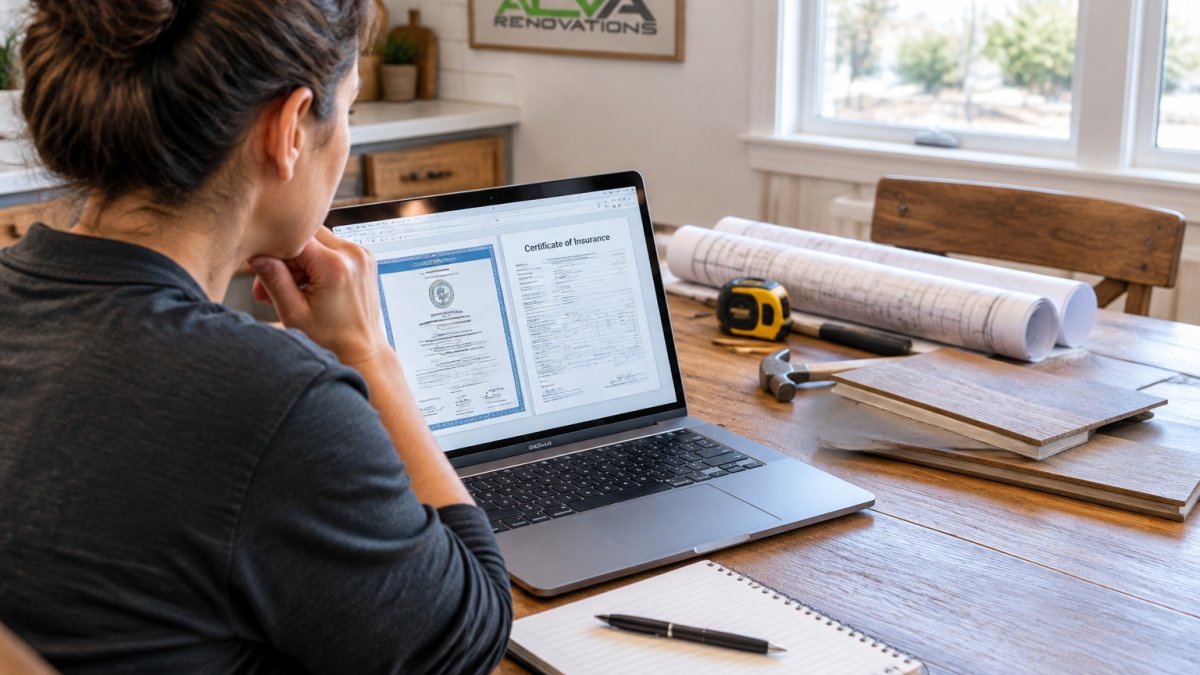
Insurance deserves the same attention. Ask for a current certificate of insurance listing general liability and workers’ compensation coverage, and call the insurer or agent listed to confirm it is active.
Request at least two references for projects similar in size and type to yours. Call them and ask about timeliness, budget control, how problems were handled, and whether the crew communicated well. A contractor with good work should share references without hesitation.
Verifying Identity and Work History From a Distance
Remote hiring raises a question local hiring rarely does: is the person you are talking to the person who will actually do the work? Ask for a video call with the owner or lead contractor, not just a phone call, and ask them to show their driver’s license and contractor license side by side.
For work history, ask for dated photos of completed projects with the address or cross streets visible where privacy allows, plus the name of a client who can confirm the project. Cross-check the photos against the contractor’s public listings or reviews.
Screening for Red Flags Before You Commit
A few patterns should end the conversation early. A contractor who asks for a large upfront payment before any contract is signed, who will not provide a written scope, who pressures you to decide quickly, or who refuses a video walkthrough is showing you how the project will go. The same applies to one who cannot explain who will be on site, whether subs will be used, and who supervises them.
Common mistakes to avoid:
- Accepting a license number without checking the state record
- Trusting a certificate of insurance without confirming the policy is active and dated for your project
- Hiring based on one glowing review with no past projects you can verify
- Skipping the W-9 and business registry check because the bid looked professional
- Letting a contractor talk you out of a video walkthrough
Using Photos, Video Calls and Local Walkthroughs
Photos and video calls let you see the work and the site without travel. Ask the contractor to walk through the property on a video call while you direct the camera to the areas that matter most.
A local walkthrough is worth the cost when the project is large or complex.
Use the same process for every contractor you consider. Consistent steps make it much easier to compare bids and spot the one that understands the work.
Writing a Contractor Estimate and Scope of Work for Off-Site Projects
A written scope of work is the foundation of any remote project. It defines what will be done, what materials will be used, what is excluded, and how the work will be verified.
Ask every contractor to base their estimate on the same scope document. Include the property address, the specific areas to be worked on, measurements where known, photos, and the expected start and finish dates.
A detailed estimate separates labor, materials, permits, disposal, and contingency. Ask the contractor to explain how they priced each category.
What a Remote Property Repair Checklist Should Cover
A repair checklist helps you confirm nothing is missed when the property is far away.
The checklist should cover access arrangements, including who holds keys and how the crew will enter the property. It should also address utilities, water shutoff locations, and any alarm or security codes the crew will need.
Other items to include are permit requirements, inspection dates, material delivery locations, waste removal, and a final walkthrough process. Confirm who will sign off on completed work and what documentation you will receive at the end.
Contracts, Payment Schedules and Change Orders
A written contract should name both parties, describe the scope, state the total price, and set the payment schedule.
Avoid large upfront payments. Many experienced contractors ask for a deposit and then tie later payments to completed milestones you can verify through photos or inspection. A common structure is a modest deposit, then payments at defined stages, demolition complete, rough-in inspected, finishes installed, final walkthrough, with retainage held until punch-list items are closed.
What the Contract Should Include for a Remote Project
At minimum, the contract should include:
- The legal names of both parties and the property address
- A detailed scope of work, with exclusions listed
- The total price and the payment schedule tied to milestones
- Start and completion dates, and what happens if they slip
- Who supervises the crew and whether subcontractors will be used
- Permit responsibility and who pulls them
- Insurance and license requirements, with certificate deadlines
- A change-order process requiring written approval before work proceeds
- A dispute-resolution clause and the state whose law governs
- A lien waiver requirement tied to each payment
Watch out: A contract that lists a lump sum with no milestone schedule gives you no lever if the work stalls halfway through.
Payment Controls, Invoices and Lien Waivers
Tie each payment to a specific, documented stage of work. Never pay in full before the work is finished and inspected. Keep a record of every payment, including the date, amount, method, and the invoice it corresponds to.
Require a written invoice for each payment request that references the milestone and the contract. Before releasing payment, ask for a conditional lien waiver from the contractor and, where the state allows, from major subcontractors and suppliers.
Watch out: Paying a contractor who then fails to pay a subcontractor can leave you with a lien on the property even though you paid in full.
Change Orders and Fraud Prevention
Change orders are unavoidable in most renovation projects. Require that every change be written, priced, and approved by you before the work is performed.
Remote owners are also targets for payment fraud. Confirm any request to change banking details by calling the contractor at a number you already have on file, not the number in the email requesting the change.
Keep a record of every payment, change order, and approval in one place. If a dispute arises, that record is the difference between a resolvable disagreement and a costly one.
The article’s key payment and contract safeguards can be scanned at a glance:
| Item | Recommended practice | Why it matters |
|---|---|---|
| Upfront deposit | Modest deposit, not full payment | Keeps leverage until work is verified |
| Payment timing | Tied to completed, verified milestones | Money follows verified work |
| Retainage | Held until punch-list items are closed | Protects against unfinished work |
| Lien waiver | Required with each payment | Blocks unpaid subcontractor liens |
| Change orders | Written, priced and approved before work | Prevents disputes over extra work |
| Banking changes | Confirmed by phone with a known number | Guards against payment fraud |
Managing Contractors Remotely Without Losing Control
Remote oversight depends on regular, structured communication. Agree on a schedule for updates, such as a weekly call and a photo report at the end of each work day or week.
Keep your own project log. Record each call, decision, change order, and payment with the date. This log protects you if questions come up later and gives any future contractor a clear history of the work.
Set clear approval points. Decide in advance which decisions you must approve, such as material substitutions or changes above a set dollar amount, and which the contractor can handle alone.
Booking Your First Remote Project With ALVA RENOVATIONS LLC
If you own a property that is hard to visit, ALVA RENOVATIONS LLC provides residential remodeling services designed for owners who need a clear process, consistent updates, and structured project communication. Our approach follows the steps above: documented scopes, written estimates, milestone-based payment schedules, and regular progress reporting.
To start, review our residential remodeling services to see the types of projects we handle, or read our full range of residential and commercial services to compare options. When you are ready to talk through your property, contact ALVA RENOVATIONS LLC to request a free estimate and discuss how we can manage your project from a distance.
Frequently Asked Questions
How do you find contractors for a remote property?
Start with referrals from property managers, local real estate agents and neighbors who own homes nearby, then check each candidate’s state license, insurance certificate and recent reviews. Ask for two or three references on projects similar to yours, preferably ones completed at a distance. Contractors who already work with remote owners usually have a clear process for photos, updates and payment, which makes them easier to manage from afar. Confirm that a licensed local contact is available for emergencies.
How do you vet a contractor when you cannot visit the property?
Request a video walkthrough of the site, ask the contractor to describe the work in their own words, and compare their scope against your own photos and measurements. Verify the license with your state’s contractor licensing board and confirm general liability and workers’ compensation coverage directly with the insurer. A contractor who asks specific questions about access, materials and existing conditions is usually paying attention. Vague answers or pressure to pay a large deposit upfront are warning signs.
What should a remote property repair contract include?
The contract should name both parties, describe the scope of work in detail, list materials and who supplies them, and set a start date, completion date and payment schedule tied to milestones. Include a clause for change orders that requires written approval before extra work begins, plus warranty terms and a process for resolving disputes. Add access instructions, a lockbox or key arrangement, and permission for the owner or a designated representative to inspect progress.
How do you handle payments and change orders with an off-site contractor?
Tie payments to completed milestones documented with dated photos or inspection reports, and avoid paying more than a modest deposit before work begins. Route all change orders through a written document that states the added cost and schedule impact, and require your signature before the work proceeds. Pay by traceable methods such as check or bank transfer rather than cash, and keep copies of every invoice, receipt and approval.
